
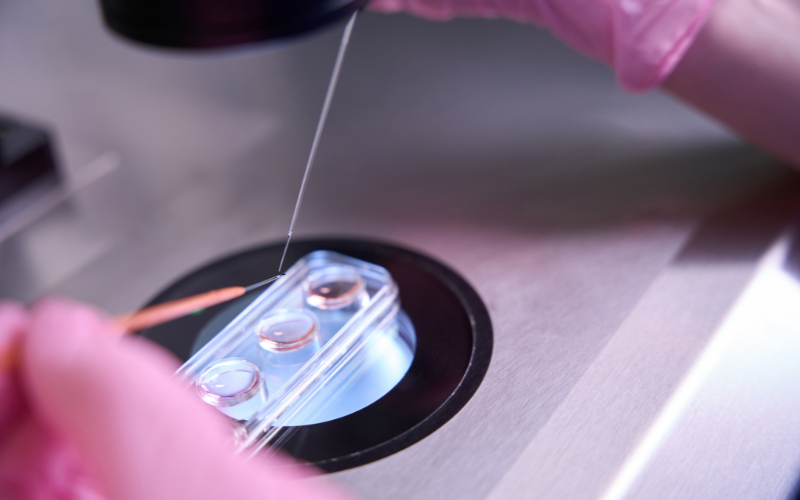
For some couples, the biggest fertility challenge is not getting pregnant but understanding why fertilisation may not be happening as expected. Problems with sperm count, movement, or the ability of sperm to fertilise an egg can make conception difficult. This is where ICSI may become relevant. An ICSI center in Kolkata can provide specialised laboratory support for this technique, but understanding when it is actually needed matters just as much as finding a centre that offers it.
What is ICSI?
ICSI stands for intracytoplasmic sperm injection. In ICSI, a single sperm is introduced directly into the cytoplasm of an ovum in a laboratory setting. Unlike conventional fertilisation, in which the sperm and egg are simply put together, with fertilisation occurring without the introduction of a sperm into the egg, ICSI allows the selected sperm direct access to the egg.
What Problems Can Make ICSI Worth Considering?
Fertility issues among men tend to vary. A semen test could reveal that there is a very low number of sperm, poor mobility, or abnormalities in terms of their morphology. In some instances, there may not be many sperm available, which would make conventional fertilization hard.
ICSI can also be performed in situations where sperm need to be retrieved surgically. There is also the case of previous treatments where not many eggs were fertilized or even no egg was fertilized.
Nevertheless, the results of the semen test should never be interpreted in isolation. Fertility issues of the woman should also be taken into consideration. These include her age, ovarian reserve, egg maturity, previous treatment, among others.
This is why searching for the best ICSI clinic in Kolkata should involve more than comparing facilities. Patients should understand how the clinic assesses both partners and how it decides whether ICSI is appropriate.
How Does ICSI Actually Work?
ICSI takes place during a fertility treatment cycle that involves retrieving mature eggs. Once the eggs are collected, the embryology team examines them and identifies those suitable for injection.
A single sperm is then carefully selected under a microscope. Using specialised laboratory equipment, the embryologist injects that sperm directly into the mature egg.
After injection, the eggs are monitored to see whether fertilisation occurs. Fertilised eggs may continue developing into embryos over the following days. Depending on the treatment plan, an embryo may later be transferred to the uterus or frozen for future use.
The patient does not physically feel the sperm being injected because this part happens entirely inside the laboratory. The medical experience is more closely connected to the overall treatment cycle, including medication, monitoring, and egg retrieval.
Does Everyone With Fertility Problems Need ICSI?
No, this is crucial.
ICSI was primarily developed to overcome issues in fertilization associated with male factor infertility. It can also be used after failed fertilization in previous cycles. However, recent studies do not recommend using ICSI in all cases where there is no male factor infertility or failure of fertilization in previous cycles. According to the American Society for Reproductive Medicine, routine use of ICSI does not increase the chance of a live birth in such cases.
Thus, choosing an ICSI center in Kolkata cannot be done on the basis that ICSI is always better than conventional fertilization.
For instance, a patient who has normal sperm parameters and has never had any previous problem in fertilization does not require ICSI.
What Should You Ask Before Choosing a Clinic?
Fertility treatment involves several decisions, and patients often have many questions before starting. Understanding why ICSI has been recommended is one of the most important.
Ask whether the recommendation is based on semen analysis, previous fertilisation results, or another specific factor. It is also reasonable to ask whether conventional fertilisation would be suitable and what the expected benefits of ICSI are in your particular case.
A good consultation should leave you with an understanding of the reasoning behind the treatment rather than simply a list of procedures.
When comparing the best ICSI clinic in Kolkata, patients can also consider the experience of the embryology team, laboratory facilities, monitoring process, and communication between the fertility specialist and laboratory team.
Is ICSI a Guarantee of Pregnancy?
No, it doesn’t.
ICSI helps solve some issues with fertilization, but fertilization is just one aspect of the reproductive process. The quality of embryos, eggs, sperm, uterine conditions, age, and other health factors can influence the final result.
This is why statements about success need to be interpreted properly – increased lab assistance does not necessarily imply guaranteed pregnancy.
The idea is to detect the exact cause of infertility and use the proper treatment method.
Final Thoughts
An ICSI center in Kolkata can be an important option for couples dealing with specific fertilisation challenges, particularly certain forms of male factor infertility or previous fertilisation failure. But ICSI is not automatically required for everyone.
Understanding the reason behind the recommendation is just as important as understanding the procedure itself. A detailed fertility assessment can help determine whether ICSI is appropriate and what other options may be available.
At PHS Fertility Clinic, patients can discuss their fertility concerns, review their reports, and understand where ICSI may fit into their treatment plan. The focus should always remain on choosing an approach that matches the individual’s medical situation.
FAQs
What is ICSI used for?
ICSI is mainly used when fertilisation may be difficult, especially in certain male factor infertility cases or after previous fertilisation failure.
Is ICSI different from conventional fertilisation?
Yes. ICSI involves directly injecting one sperm into a mature egg, while conventional fertilisation allows sperm and egg to interact without direct injection.
Does ICSI guarantee a successful pregnancy?
No. ICSI can address fertilisation problems, but several other factors influence pregnancy and live birth.
Get our direction: https://maps.app.goo.gl/rmBroSr6LwfzMvMD9