
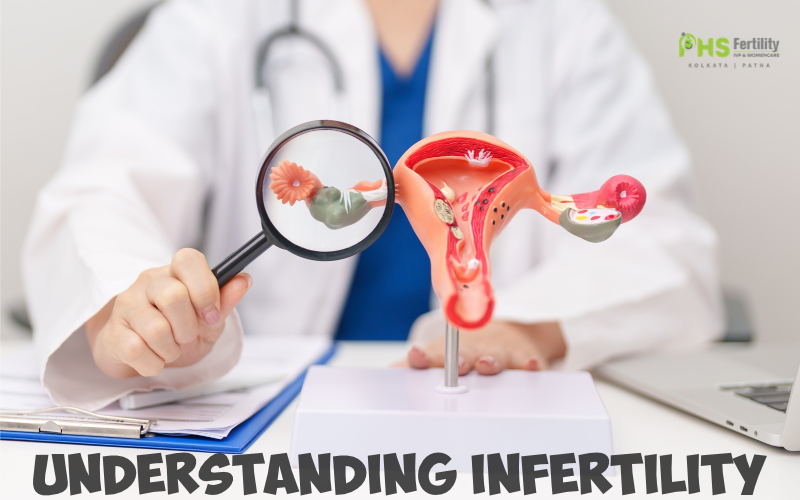
Struggling to conceive can be emotionally challenging, especially when IVF seems like the only solution. But is IVF necessary for every infertile couple? The answer is no. Several fertility treatment options may help couples conceive without immediately undergoing IVF.
From lifestyle changes and fertility medications to ovulation induction and IUI, treatment depends on the underlying cause. At PHS Fertility Clinic, the importance of understanding individual fertility concerns highlights a key principle of reproductive healthcare: every couple deserves a diagnosis-based treatment plan.
Understanding Infertility: Why Are Couples Struggling to Conceive?
Infertility generally means difficulty achieving pregnancy after 12 months of regular, unprotected intercourse. According to the World Health Organization, approximately one in six adults worldwide experiences infertility during their lifetime.
Infertility may involve either partner or a combination of factors.
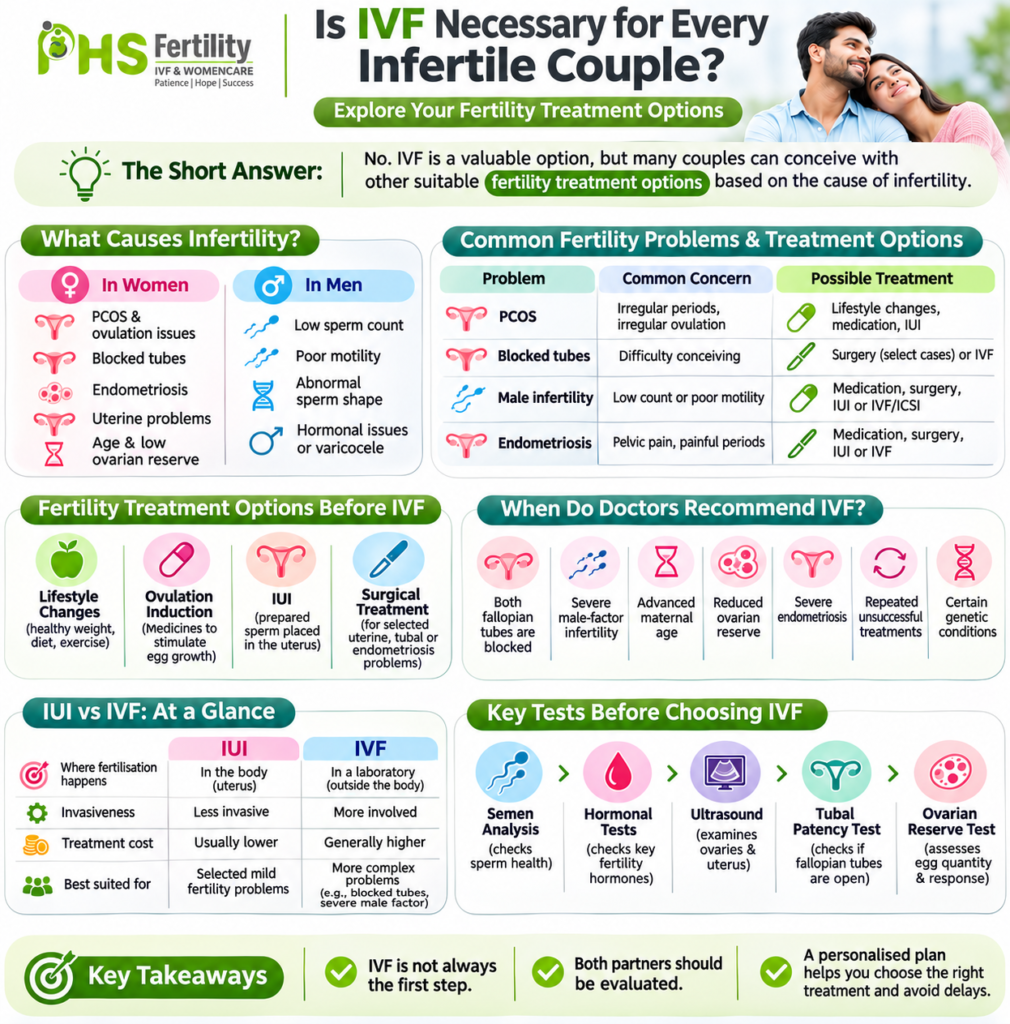
Common causes of female infertility:
- Polycystic ovary syndrome (PCOS) and irregular ovulation
- Blocked or damaged fallopian tubes
- Endometriosis and uterine abnormalities
- Reduced ovarian reserve and age-related fertility decline
Common causes of male infertility:
- Low sperm count or poor sperm motility
- Abnormal sperm morphology
- Hormonal disorders or varicocele
- Certain genetic conditions and reproductive tract problems
Sometimes, standard investigations reveal no clear explanation, resulting in a diagnosis of unexplained infertility.
Understanding the cause helps specialists identify appropriate fertility treatment options rather than recommending IVF automatically.
Get the best guidance from the best IVF doctor in Kolkata -Dr. Prajnanika Gurung
Common Fertility Problems That May Not Require IVF
Different reproductive conditions require different approaches. Some respond to medication or lifestyle modifications, while others may require surgery or assisted reproduction.
| Fertility problem | Common concerns | Possible treatment |
|---|---|---|
| PCOS | Irregular periods and ovulation | Lifestyle changes, ovulation induction |
| Blocked fallopian tubes | Difficulty conceiving, often without symptoms | Selected surgery or IVF |
| Male infertility | Low sperm count or motility | Cause-specific medication, surgery, IUI or IVF/ICSI |
| Endometriosis | Pelvic pain, painful periods | Selected surgery, IUI or IVF |
| Ovulation disorders | Irregular or absent ovulation | Ovulation induction and monitoring |
| Unexplained infertility | Normal standard test findings | Expectant management, stimulated IUI or IVF |
| Low ovarian reserve | Reduced egg quantity | Individualised fertility treatment |
| Uterine abnormalities | Fibroids, polyps or structural concerns | Selected hysteroscopic or surgical treatment |
| Age-related infertility | Declining egg quantity and quality | Timely evaluation and appropriate assisted reproduction |
For example, PCOS treatment without IVF is often possible when irregular ovulation is the primary difficulty. International clinical guidelines recommend letrozole as a first-line medication for ovulation induction in eligible women with PCOS and no additional infertility factors.
However, blocked fallopian tubes treatment depends on the location and severity of the blockage. IVF may be more appropriate when both tubes are severely damaged.
The important point is that no single treatment works for every fertility problem.
Read more: https://phsfertilityclinic.com/pcos-and-pregnancy-can-you-conceive-naturally/
Can You Get Pregnant Without IVF? Fertility Treatment Options to Consider
Yes. Depending on the diagnosis, pregnancy without IVF may be achievable through several approaches.
1. Lifestyle Modifications
Maintaining a healthy weight, eating a balanced diet, exercising regularly and avoiding smoking can support reproductive health.
Improving sleep and managing stress may also support general well-being. However, lifestyle changes alone cannot correct every underlying cause of infertility.
2. Ovulation Induction
Women experiencing irregular or absent ovulation may benefit from prescribed fertility medication.
Medicines such as letrozole can stimulate ovulation in suitable patients, while ultrasound follicular monitoring helps assess the ovarian response and guide treatment.
3. Intrauterine Insemination (IUI)
IUI involves placing prepared sperm directly into the uterus around ovulation.
It may be considered for selected couples with unexplained infertility or mild male-factor infertility, provided other requirements, including suitable fallopian tube function, are met.
4. Surgical Treatment
Certain uterine polyps, fibroids, tubal conditions or cases of endometriosis may benefit from carefully selected surgical procedures.
Surgery is not universally necessary, and its potential benefits must be weighed against the risks.
5. Male Infertility Treatment Without IVF
Depending on the cause, male infertility treatment without IVF may include lifestyle improvements, treatment of hormonal disorders or surgery for selected conditions.
More severe sperm abnormalities may require assisted reproduction.
These approaches demonstrate why proper evaluation should come before choosing a fertility procedure.
When Do Doctors Recommend IVF?
Although infertility treatment without IVF is possible for many couples, there are situations where IVF may offer a more suitable route to pregnancy.
Doctors may recommend IVF when:
- Both fallopian tubes are severely blocked or damaged, preventing eggs and sperm from meeting normally.
- Severe male-factor infertility makes conventional conception or IUI unlikely to succeed; IVF with ICSI may be considered.
- Advanced maternal age makes prolonged delays with less effective treatments undesirable.
- Reduced ovarian reserve raises concerns about available time and response to fertility treatment.
- Severe endometriosis significantly affects reproductive function.
- Repeated unsuccessful treatment cycles suggest that moving to IVF may be appropriate.
- Certain inherited genetic conditions make IVF with preimplantation genetic testing a possible option.
Importantly, reduced ovarian reserve does not automatically mean natural conception is impossible. Decisions require consideration of age, medical history and other fertility findings.
IUI vs IVF: Which Fertility Treatment Is Right for You?
IUI and IVF are both established assisted reproductive treatments, but they differ considerably.
| IUI | IVF |
|---|---|
| Fertilisation occurs inside the body | Fertilisation occurs in a laboratory |
| Less invasive procedure | Involves ovarian stimulation and egg retrieval |
| Usually lower treatment cost | Generally higher treatment cost |
| Suitable for selected mild fertility problems | Often suitable for more complex infertility |
IUI may be a reasonable early treatment for some couples, but it is not appropriate when both fallopian tubes are blocked.
According to the American Society for Reproductive Medicine, many couples with unexplained infertility may begin with three or four cycles of ovarian stimulation combined with IUI before considering IVF.
The appropriate choice depends on individual circumstances rather than one treatment being universally better.
What Tests Should Couples Take Before Choosing IVF?
Before selecting among fertility treatment options, both partners should undergo appropriate assessment.
Common investigations include:
- Semen analysis: Evaluates sperm concentration, movement and morphology.
- Ovulation assessment: Helps determine whether ovulation occurs regularly.
- Hormonal testing: May identify thyroid, prolactin or other relevant hormonal problems.
- Pelvic ultrasound: Examines the ovaries and uterus.
- Tubal patency testing: HSG or suitable ultrasound-based procedures help assess whether the fallopian tubes are open.
- Ovarian reserve assessment: AMH testing and antral follicle count may help guide treatment planning.
Not every patient requires every investigation.
A fertility expert can interpret the findings and explain suitable alternatives. Couples consulting an IVF doctor in Kolkata should also understand whether less invasive treatment is appropriate before proceeding with IVF.
Frequently Asked Questions
Can I get pregnant naturally after being diagnosed with infertility?
Yes. Natural pregnancy after infertility is possible in some cases, depending on age, the underlying condition and reproductive health. However, it cannot be guaranteed.
Can infertility be treated without IVF?
Yes. Ovulation medications, IUI, cause-specific medical treatment and selected surgery may help some couples conceive without IVF.
How do I know if I really need IVF?
A fertility specialist can assess semen quality, ovulation, tubal health, age and previous treatment outcomes before recommending IVF.
Can a fertility specialist recommend treatment other than IVF?
Absolutely. Depending on the diagnosis, a specialist may recommend monitored natural conception, ovulation induction, IUI or another appropriate treatment.
How long should couples try other fertility treatments before IVF?
There is no universal timeline. Some couples may try three or four stimulated IUI cycles, while others may benefit from earlier IVF based on age or medical findings.
Is pregnancy possible after years of infertility without IVF?
Yes, in selected situations. However, prolonged infertility warrants medical evaluation rather than continuing to wait without understanding the cause.
Conclusion: Choose the Right Treatment, Not Just IVF
IVF is not necessary for every infertile couple. The best approach begins with understanding the causes of infertility, evaluating both partners and choosing treatment based on individual needs.
Whether the solution involves lifestyle changes, fertility medication, IUI or IVF, appropriate diagnosis helps couples make informed decisions.
The patient-centred approach discussed in relation to PHS Fertility Clinic reinforces a simple principle: fertility care should focus on finding the most suitable treatment, rather than assuming IVF is always the first step.
Get our direction: https://maps.app.goo.gl/JijcdgKmmNSFy8Eh6